iMano

A Generalizable Computational Framework for Antibodies and Nanobodies Humanization

Fudan University & Suzhou Forlong Biotechnology Co., LTD

Research Background

Monoclonal antibodies (mAbs) and nanobodies (Nbs) are core therapeutic tools, but animal-derived antibodies trigger immunogenicity (e.g., HAMA responses) in humans. Antibody humanization is critical to mitigate this risk.

Conventional CDR grafting is labor-intensive (requiring iterative back mutation screening) and relies on resolved antigen-antibody complex structures. iMano addresses these limitations via computational biology, enabling efficient humanization without complex experimental structures.

Abstract

Antibody humanization is a critical step in therapeutic antibody development, aiming to minimize immunogenicity arising from non-human sequences. However, conventional CDR grafting techniques are labor-intensive and retain extensive framework beyond CDR regions. Here, we present a computational strategy, iMano, for antibody humanization that streamlines the traditionally iterative trial-and-error process. By leveraging RMSD-based structural evaluation and integrating residue-level positional and energetic information into residue selection, iMano enables rational framework design without requiring experimentally resolved antigen-antibody complex structures. In four representative cases, including a nanobody, the approach produced highly humanized variants that maintained strong binding activity, with only a limited number of candidates requiring experimental screening. These results demonstrate the potential of this computational strategy to accelerate antibody humanization while preserving specificity and affinity, offering a flexible and broadly useful solution for antibody engineering across diverse formats and antigen targets.

Core Workflow

iMano's Core Workflow

Fig.1A

Pipeline Overview
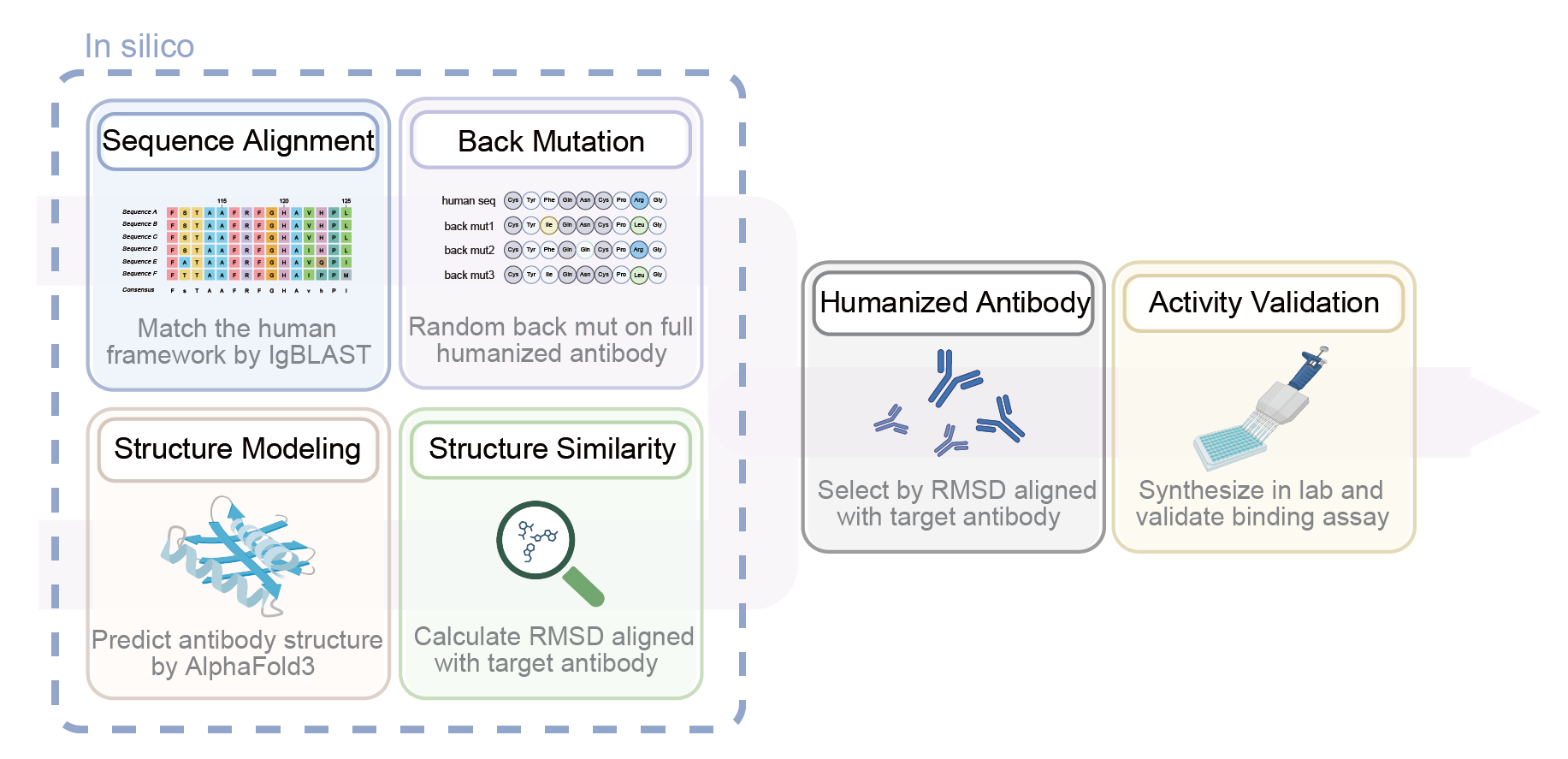
iMano pipeline

Key steps: ① IgBLAST germline matching → ② AlphaFold3 structure prediction → ③ RMSD screening → ④ Binding validation.

Fig.1BC

Residue Selection & Candidate Generation
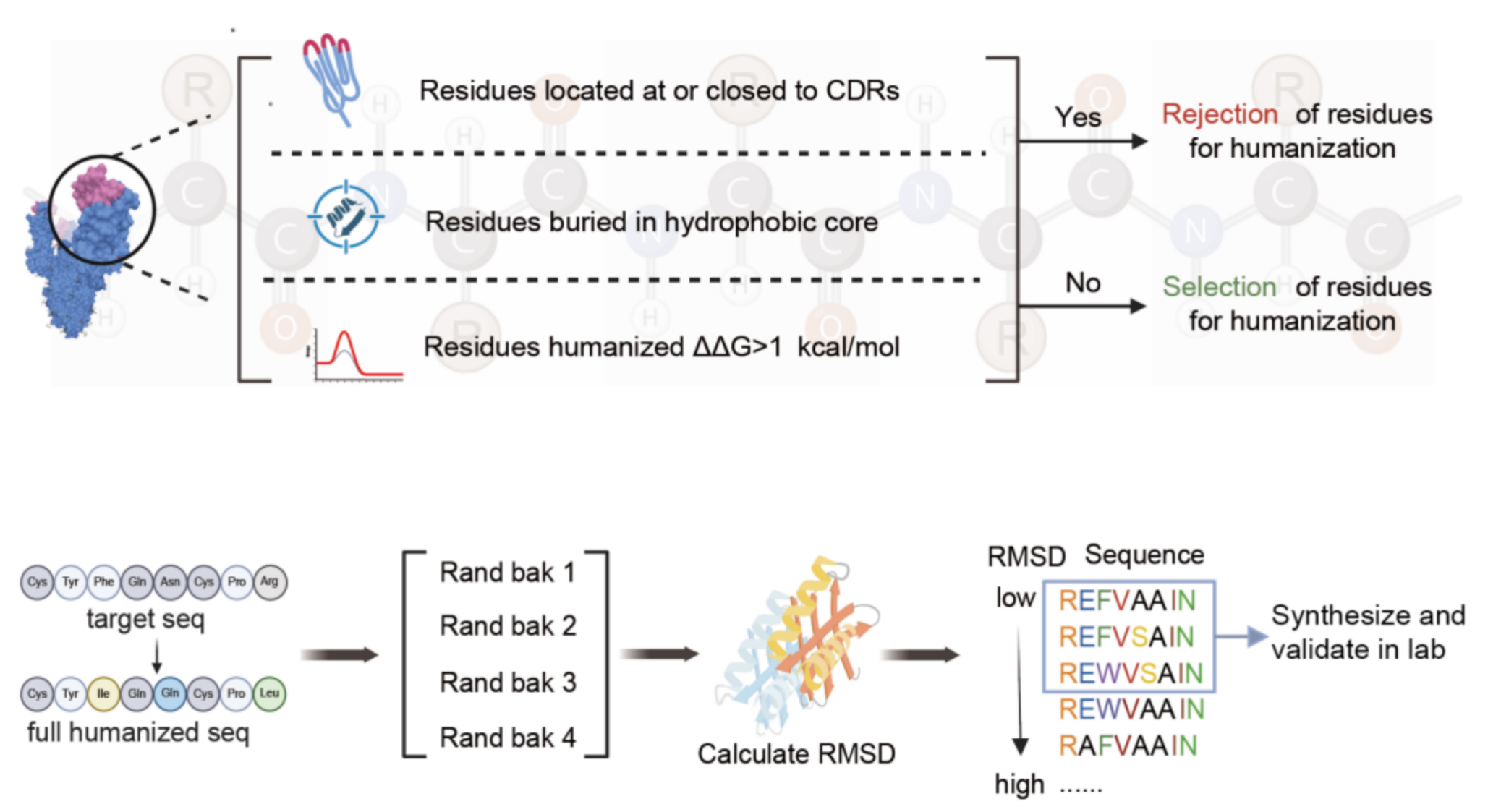
iMano residue-selection

Core logic: Fix hydrophobic core residues (ΔΔG < 1 kcal/mol) + max 4 back mutations per chain + prioritize low CDR RMSD candidates.

Key Advantages

No Complex Structural Requirement

Design humanized antibodies using only sequence data, no experimentally resolved antigen-antibody complex structures needed.

Broad Applicability

Compatible with monoclonal antibodies (mAbs) and nanobodies (Nbs), adapting to diverse antigen targets.

High Efficiency

Streamlines trial-and-error iteration, requiring only 3-6 candidates for experimental screening (reduces workload significantly).

Balanced Performance

High humanization degree (85-88% for mAbs, 73% for Nbs) while preserving parental antibody binding affinity.

Academic Information

Authors & Contributions

Equal Contribution: Yi Feng, Ruohan Zhu, Xiaojie Ma, Litong Liu

Corresponding Authors: Tianlei Ying (tlying@fudan.edu.cn), Yanling Wu (yanlingwu@fudan.edu.cn)

Funding & Keywords

Supported by: National Natural Science Foundation of China, Shanghai Science and Technology Commission, Fudan University.

Keywords: Antibody humanization, antibody engineering, RMSD-based modeling