Generative Prediction of Antibody Conformational Ensembles Using Denoising Diffusion Probabilistic Models

This work is being submitted.

Chao Peng1,#, Ziming Suo2,#, Zelong Wang1, Ali Nobakhtnamini1, Yi Feng2, Juncheng Qian2, Yu Kong2, Chuang Qin2, Zifei Wang2, Yanling Wu2,3,*, Weifeng Ge1,*, Tianlei Ying2,3,4,*
1 College of Computer Science and Artificial Intelligence, Fudan University, Shanghai, China. 2 Key Laboratory of Medical Molecular Virology (MOE/NHC/CAMS), Shanghai Institute of Infectious Disease and Biosecurity, School of Basic Medical Sciences, Department of Pulmonary and Critical Care Medicine, Department of Liver Surgery and Transplantation, Zhongshan Hospital, Fudan University, Shanghai, China. 3 Shanghai Engineering Research Center for Synthetic Immunology and Shanghai Key Laboratory of Lung Inflammation and Injury, Shanghai, China. 4 Shanghai Innovation Institute, Shanghai, China. # These authors contributed equally. * Corresponding author.
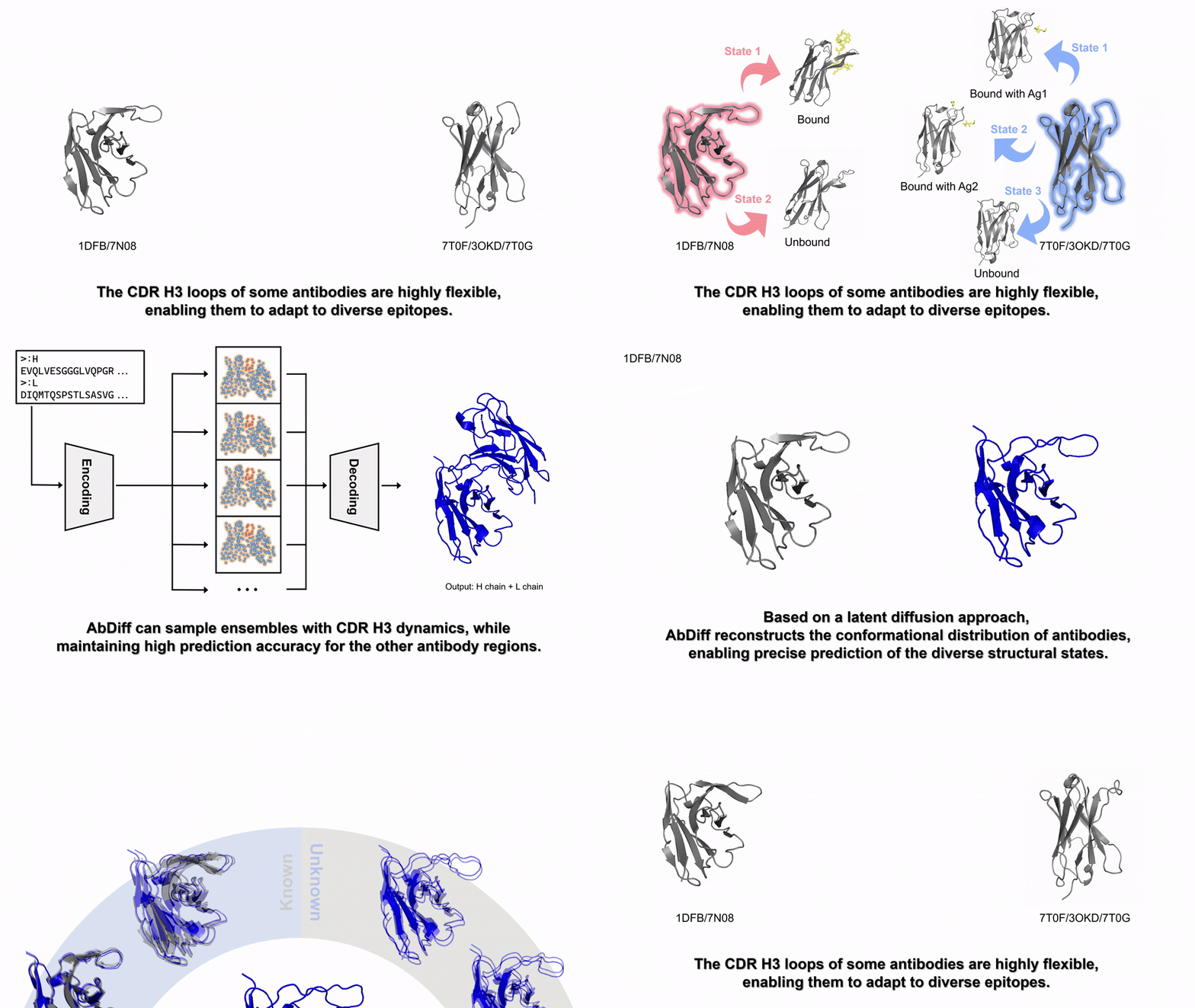
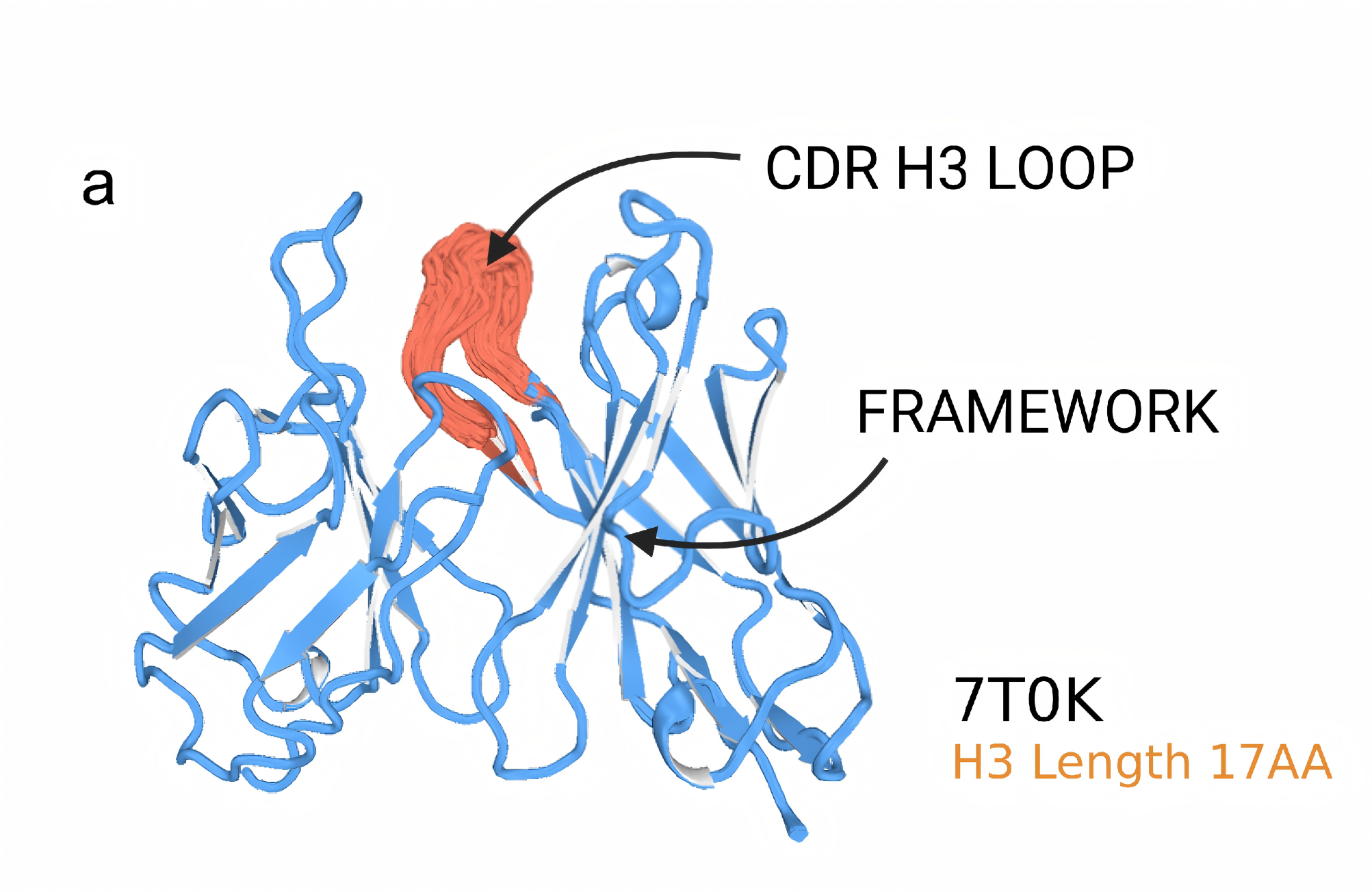
AbDiff is a novel tool for the conformational sampling of antibodies with CDR H3 flexibility.

Abstract

In recent years, deep learning has achieved remarkable progress in antibody conformational sampling. Nevertheless, mainstream models still struggle to accurately sample the CDR H3 loop region, likely due to its intrinsically disordered or highly flexible characteristics. Based on insights from antibody structural biology, we propose that the outcome of antibody conformation prediction should be regarded as an ensemble rather than a single static structure. In this study, we demonstrate that by introducing a diffusion process into conventional antibody structure prediction frameworks which originally built upon homologous and language features, we can model the diffusion of structural data distributions and effectively learn their underlying conformational landscape. This approach enables the construction of a generative network capable of sampling antibody variable region ensembles with all-atom precision. Importantly, it maintains backbone accuracy within the framework region while allowing controlled conformational variability in the H3 loop. We term this method AbDiff, and validate its performance using a multi-conformational antibody dataset derived from AbAgDb. Cross-model comparisons reveal that AbDiff exhibits superior geometric validity and conformational diversity relative to existing approaches, and demonstrates sub-angstrom level reliability in residue-level local accuracy and contact prediction, providing a robust and biophysically grounded tool for antibody modeling and analysis.

Approach

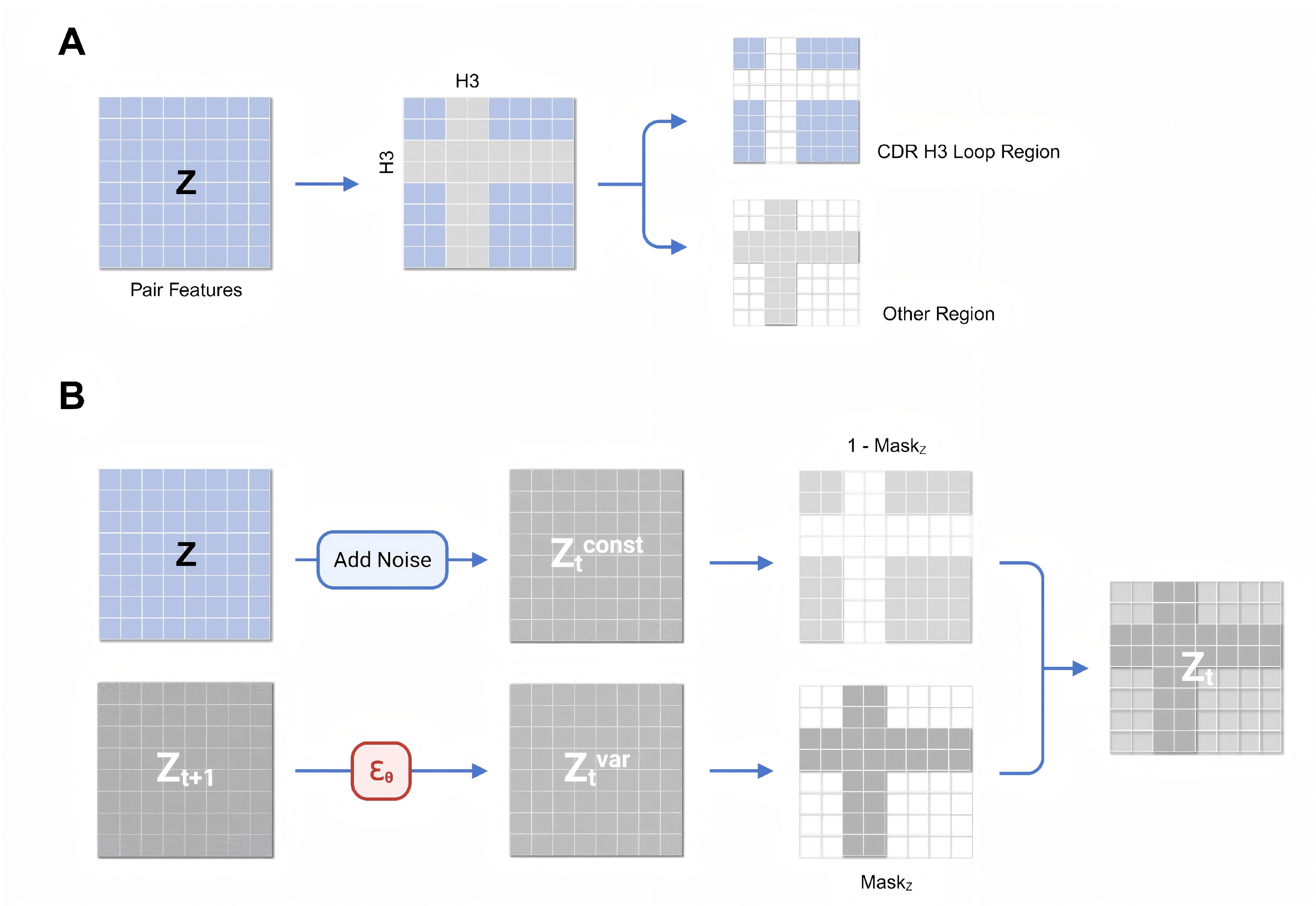

First, the encoder extracts pairwise structural features and sequence embeddings from the input antibody sequence, followed by the addition of Gaussian noise to the pairwise features. The diffusion model then predicts the noise at each step, conditioned on the sequence embeddings and diffusion timestep, and incrementally denoises the pairwise features. Throughout the denoising process, pairwise features unrelated to the H3 loop are replaced with their original values to anchor the framework. After the final denoising step, the decoder reconstructs fullatom antibody structures from the refined features, producing conformational ensembles focused on CDR-H3 variability.


Achieve Full-Atomic Precision Prediction of Antibody Conformational Ensembles

AbDiff is particularly well-suited for predicting antibody ensembles characterized by high conformational diversity. It’s an end-to-end predictive framework capable of directly generating full-atom Fv (VH+VL) conformational ensembles from antibody sequences.

Outperform existing methods on benchmark datasets

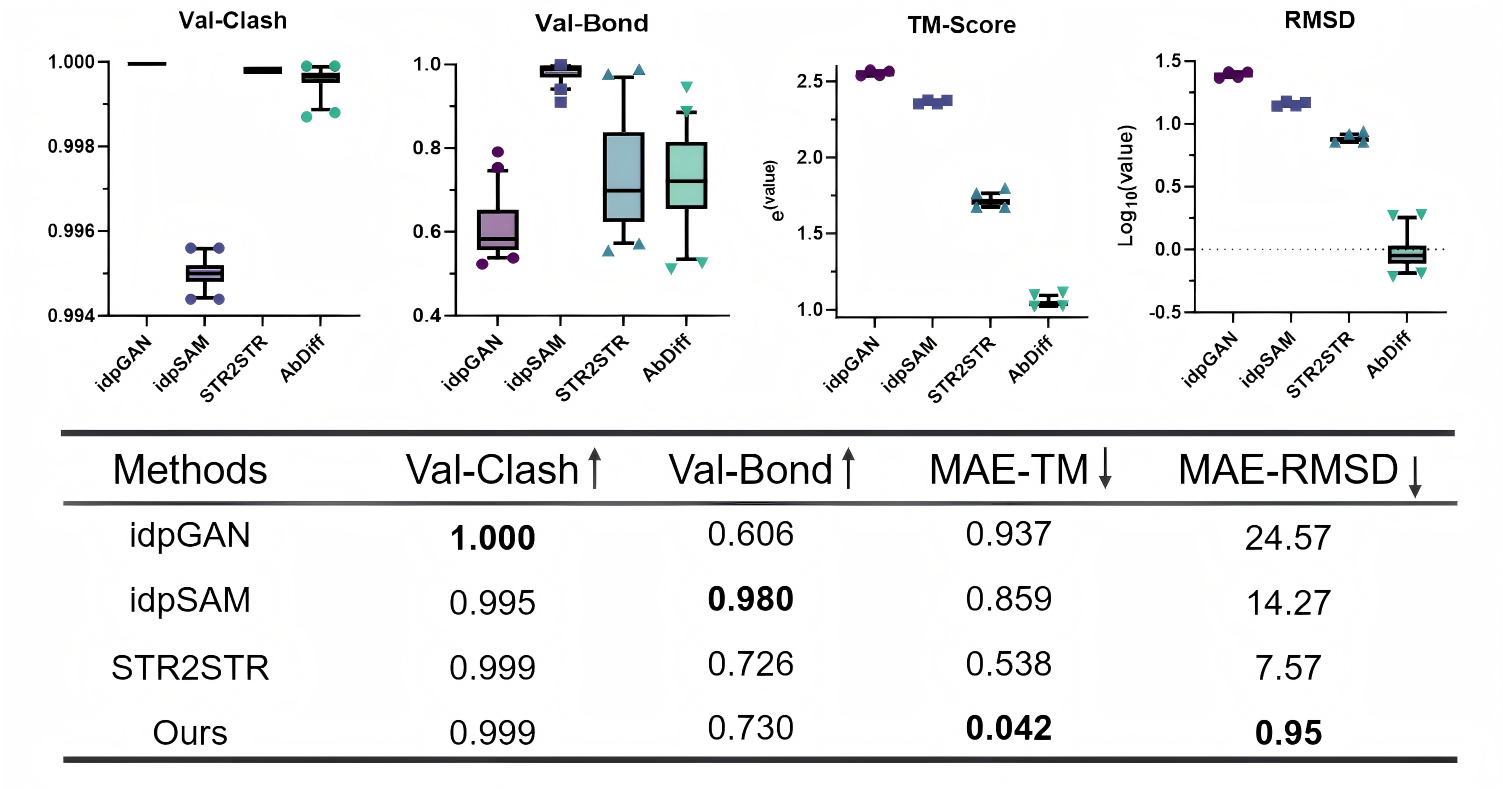
Systematic evaluation on an independent test set demonstrated that the latent diffusion–based fixed-backbone strategy achieves a favorable balance among geometric validity, conformational diversity, and accuracy relative to experimentally determined structures. Compared with several representative IDP generative methods, AbDiff outperformed in key metrics including Val-Clash, Val-Bond, TM-Score, and RMSD.

Guarantee framework region accuracy through latent space diffusion and masking mechanism

First, AbDiff obtains the antibody backbone structure—representing the relatively stable regions—using an established structural prediction model, and then to generate diverse CDR-H3 conformations while keeping this backbone fixed. This reframes the antibody conformation generation problem as: given an antibody sequence and its backbone structure, generate the conformation of the complementarity-determining region H3.

Capture diverse conformations of the same antibody

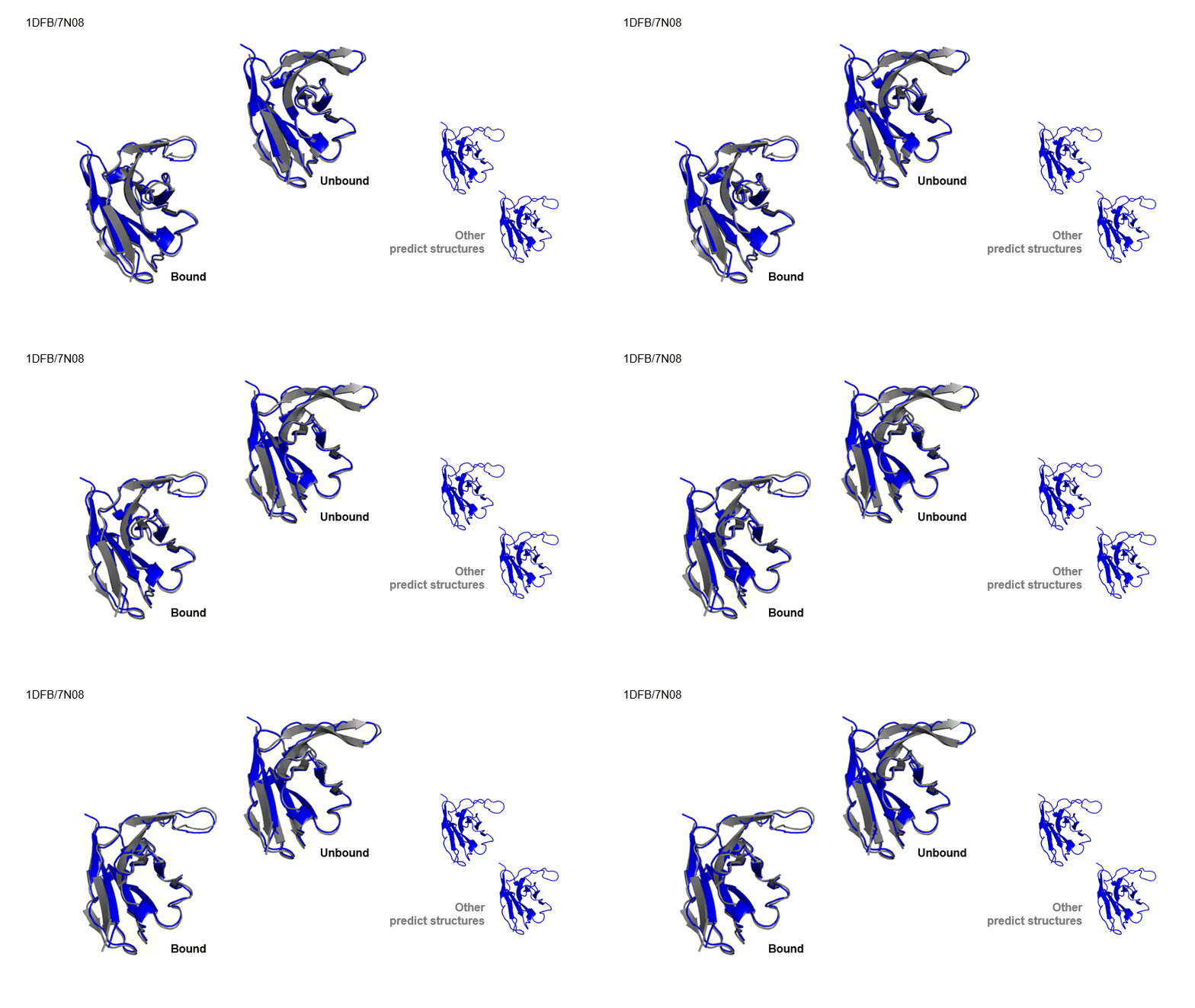
We performed 100 independent diffusion sampling runs with AbDiff for 7N08 to generate a high-diversity predicted conformational ensemble. Concurrently, a reference ensemble was assembled from the Protein Data Bank (PDB), comprising one unbound structure and three antigen-bound structures. In terms of structural accuracy, AbDiff maintained prediction errors below 1 Å for the unbound state and the bound states, demonstrating superior capability to preserve both high precision and structural consistency in multi-stable systems.

Our Other Research

AbFold

All-atom precision antibody structure predictor combining linguistic features and sequence features.

iMano

Artificial intelligence empowers various types of antibody human sources.

BibTeX

@misc{AbDiff,
 author = {Authors},
 title = {AbDiff},
 year = {2025},
 url = {https://github.com/SII-TianleiYing/AbDiff},
}